/*added another slider news box below here*/

Thursday, August 22, 2013

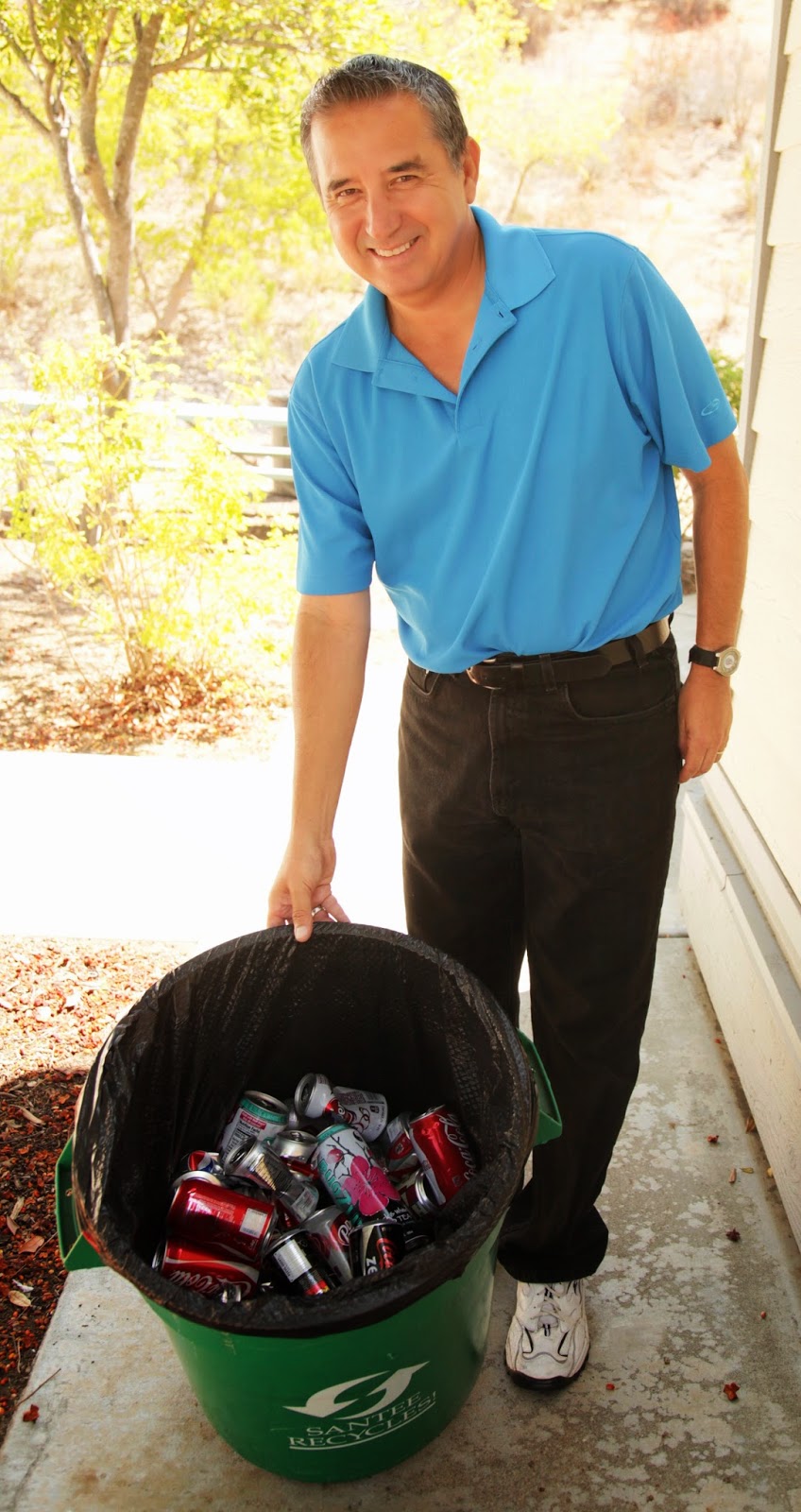
Businesses and Apartments Can Keep Santee Green by Recycling

Thursday, August 22, 2013


Recycling coordinator Ed Ruiz
 
Business owners and those who manage multi-family housing such as apartments have been required to participate in California’s mandatory commercial recycling program since July 2012.
To comply with state law, businesses that generate at least 4 cubic yards of solid waste per week and multi-family housing of five units or more must arrange for recycling services.
Businesses and multi-family housing complexes in Santee can comply by choosing any of the following options:
  • Arrange for the pickup of recyclable materials with Waste Management Inc., the city’s franchise trash hauler;
  • Arrange for the pickup of recyclable materials by a non-franchise hauler who must provide the service at no cost to the property owner;
  • Apply for an exemption at Santee City Hall and take responsibility for hauling your recyclable waste to a recycle center.
Owners of commercial businesses and managers of multi-family housing complexes may require their tenants to source separate their recyclable materials to aid in compliance with state law.
More information is available by contacting City of Santee Recycling Coordinator Ed Ruiz at (619) 258-4100 ext. 128.

Wednesday, August 21, 2013

Fixing Drains Before the Rains

Wednesday, August 21, 2013


Project site on De Vos Drive
 
Storm drain upgrades are among the most under-appreciated improvements a city can undertake, but they make a huge difference when winter rains hit.
This week, a 6-member crew from Southwest Pipeline and Trenchless Corp.  of Torrance, CA began installing new linings inside old metal storm drains that have deteriorated.

Today,  workers were refurbishing a 30-inch storm drain that runs between homes on De Vos Drive near Carlton Oaks Elementary School.
Installation requires workers to place a sock-shaped felt lining inside the pipe. The special sock, which is fabricated at the firm’s headquarters, is pushed into place first with water and then with air. The sock is impregnated with an epoxy resin that is activated when steam is injected into the pipe. The resin hardens in two to three hours, creating a new lining inside the pipe.

The process is quick enough that workers can arrive in the morning and be gone before dinner time, sparing residents the inconvenience of  road closures and heavy equipment that would otherwise block traffic.  It also allows the city to rehabilitate storm drains without expensive and annoying excavation work, said company president Justin Duchaineau, who came to check on the project site.
Justin Duchaineau of Southwest Pipeline & Trenchless Corp.
On Thursday, the crew from Southwest Pipeline  will be fixing a 36-inch diameter metal storm drain beneath Carlton Oaks Drive. The company, which was awarded a $775,576 contract in April, will return in September to rehabilitate a 60-inch diameter storm drain.

This summer, the city awarded more than $2.4 million in construction contracts to fix deteriorated metal storm drains or replace those that are beyond repair. The goal is to upgrade obsolete portions of the city’s drainage system to avoid calamities such as pipe failures and sink holes.  Santee has 6.75 miles of corrugated metal pipes (CMPs)  that were installed before the city incorporated in 1980.

Thursday, August 15, 2013

Accident Statistics Offer Insight on El Nopal-Mast Blvd. Issue

Thursday, August 15, 2013


El Nopal's sharp curves in Lakeside 
Critics claim that a traffic hazard has been created on El Nopal because the city of Santee has not completed a proposed connection of Mast Boulevard eastward into the unincorporated community of Lakeside.
This argument relies on the assumption that the cause of the accidents occurring on El Nopal will somehow disappear if and when the city and county pave the 1,000-foot gap of Mast Boulevard that exists today.

Critics refer to El Nopal as a “detour” route around the missing link of Mast Boulevard. In fact, El Nopal is a decades-old residential collector street that will remain in existence regardless of what happens with Mast Boulevard.

It should be noted that Lakeside’s portion of El Nopal has two sharp curves, which is where many of the accidents have occurred.
State accident statistics compiled over the last decade show that a majority of accidents on El Nopal were the result of speeding motorists.

From 2002 to 2012, there were 46 traffic accidents (including one fatality) along the county’s stretch of El Nopal between Los Ranchitos and Riverford roads where the “S” curves are located.  Less than 6 percent of those collisions were serious-injury accidents. The lone fatal accident occurred in 2004 and involved a motorcycle rider.
During the same 10-year period, there was one fatal accident and nine other vehicle collisions in Santee’s jurisdiction along El Nopal from Magnolia Avenue to Los Ranchitos Road.  The lone fatal accident occurred in 2005 and involved a motorcyclist who was under the influence of alcohol.

Here’s the breakdown of how the 46 accidents occurred over the past decade along the section of El Nopal containing the two sharp curves:
  • Traveling at unsafe speed -- 54.3 percent
  • Driving on wrong side of road – 19.6 percent
  • Driving under the influence  -- 13 percent
  • Improper turning – 8.7 percent
  • Right of way violations – 4.3 percent

Completing the gap on Mast Boulevard between Lakeside and Santee would cost the city of Santee $4.5 million. The county would have to spend $1.7 million to complete the Lakeside portion.
Even if the city completed the Mast Boulevard connection to the east, the sharp curves along Lakeside’s portion of El Nopal, which is governed by the county, would still remain.  The county’s transportation master plan envisions no future improvements for El Nopal, which is described as “a 2-lane road…sufficient to meet projected traffic volumes.”

Moreover, connecting Mast Boulevard through to Lakeside would increase traffic on the Santee side by an estimated 35 percent.  Completing this connection also would funnel truck traffic serving the industrial parks in Lakeside into Santee’s residential neighborhoods and past two high schools.

Completing Mast Boulevard would offer a convenient route for a few, but it will expose many Santee residents to higher traffic volumes and greater truck traffic.


Tuesday, August 13, 2013

Live from Santee: Country Hunk Tony Suraci

Tuesday, August 13, 2013


Catch a rising country heartthrob at this Thursday’s free concert at Santee’s premier live venue

Tony Suraci is a dynamic vocalist who can mimic the voices of country music’s greatest “outlaw” superstars, including Waylon Jennings, Willie Nelson and Johnny Cash.
If they cloned Eddie Vedder with Kenny Chesney, the result would be Tony Suraci.

He’s been playing sold-out shows at the Belly Up and other local night clubs. And now he’s headed to Las Vegas for a career-changing gig at the Hotel M Resort.

But before he pursues fame and fortune in Sin City,  Suraci and his band of accomplished sidemen will play at 6:30 p.m. at the outdoor performance stage at Town Center Community Park, 550 Park Center Drive. It’s his first appearance in Santee, so he deserves a warm welcome.

Bios posted on the web say Tony has worked as both a musician and actor, including a role on Melrose Place. He’s also appeared on stage in comedy, drama and dance productions since the age of 9. He can play guitar and piano, but he also has something you can’t learn: charisma.
Click here to view a YouTube video of Suraci strutting his stuff.


Thursday, August 1, 2013

Bird of the Month for August – Snowy Egret

Thursday, August 1, 2013


A member of the heron family, the snowy egret  has a slim black bill and long black legs with yellow feet.   They are about two feet  long with wingspans of three feet. We found this one foraging for food in Woodglen Vista Creek near Mast Boulevard.

The cheek area in front of the eyes  is yellow but turns red during breeding season, when they regrow fancy plumes that give them a shaggy look. They range from the lower Great Lakes and southwestern U.S. to South America.

They can be found in fresh or saltwater habitats located inland or along the coastline in marshes, swamps, shorelines, mudflats and ponds. They eat fish, crustaceans, insects, frogs and small reptiles.

Wednesday, July 31, 2013

Santee Adopts Pro-active Approach to Transient Issue

Wednesday, July 31, 2013


The city of Santee has taken a proactive approach with transients who set up illegal camp sites along the San Diego River and other greenbelt areas.
While efforts are made to connect the homeless to food, shelter and social services, the city actively discourages people from living permanently in the riverbed.

Transient encampments cause a host of problems, including increased risk of wildfires, pollution of the river from human sewage and garbage, and the perception that the community is not safe.

Sweeps Conducted Every Two Months

Deputies from the San Diego Sheriff’s Dept. conduct sweeps of the riverbed approximately every two months to locate illegal camp sites and tag them with eviction notices.
“We give them notice that they are trespassing and allow them seven to 10 days to vacate and remove their property,” said Deputy Mark Snelling with the Community Oriented Policing Unit. “If they are present when the deputies are tagging the camp sites, we can cite them for illegal camping.”
When deputies return a few weeks after the initial sweep, anyone found living at the tagged camp sites can be arrested for trespassing.

“Sometimes they move and sometimes they don’t,” Snelling said.

 43 Citations Issued in First Half of 2013

In the first six months of 2013, the sheriff’s deputies in Santee issued 43 citations for illegal camping.

After deputies have issued the illegal camping citations, the Santee City Attorney’s office pursues the charges by appearing in court to prosecute the illegal camping and related offenses. 

“This enforcement mechanism is an effective way to address issues of local concern and is a vital part of an overall strategy to ensure the high quality of life enjoyed by Santee’s citizens,” said City Manager Keith Till. “We strive to address conditions detrimental to public health and safety by actively enforcing the municipal code though the criminal prosecution of code violations.”

In addition to prosecuting illegal camping citations, the city’s attorneys obtain “stay away” orders prohibiting transients and chronic campers from returning to the riverbed in Santee.  Judges have the discretion to ban repeat offenders from re-establishing camp sites in same geographic area as a condition of suspending a fine or a jail sentence.

In addition to legal services, the city also incurs costs to have public service staffers clean up the camp sites in the riverbed after the transients have left.

“It’s very labor intensive, basically all hand work with pickup sticks and trash bags” said Public Services Supervisor Sam Rensberry, who cleans up the sites with help from another staff member. 

“I can’t sugarcoat it. It’s hot, sweaty and disgusting,” Rensberry said.  “The smell is terrible. There are ants, bugs, human waste and sometimes needles left behind.”

To comply with recent court rulings, the city takes any personal property left behind by illegal campers to the public services headquarters.  If it is not claimed in 90 days, the property is thrown away.

 Transient Population Difficult to Estimate

It’s difficult to estimate the number of people camping in the riverbed at any given time because the population is constantly in flux, said Deputy Snelling.

Volunteers with the Regional Task Force on the Homeless inspected Santee in January and tallied 18 people living unsheltered or in their cars. However, at least one local official estimated there may be 30 to 35 people illegally camping in the riparian area along the river.

A survey in April 2013 by the San Diego River Park Foundation identified 160 active encampments along 30 miles of the San Diego River from the El Capitan Reservoir to the Pacific Ocean.

Authorities say the population of illegal campers generally falls within three categories: Chronic homeless who do have local families or connections; transients who hopscotch from city to city; and alcoholics and drug addicts who can be as young as teenagers.

 Most Do Not Have Violent History

“Most of the people camping in the river bottom have alcohol and drug dependency issues, but for the most part they do not have a violent history,” Snelling said.  “There is a criminal element that lives out there, but it’s a minor percentage.”

 Transients camping along the river are themselves at risk. They can be swept away by flash floods. Their living conditions are basically unsanitary. They are also vulnerable to being assaulted.

“There has been more violent crime committed against the homeless than they have perpetrated themselves,” Snelling said.

 The San Diego River Park Foundation, a nonprofit conservation group, has been documenting the effects of homeless encampments along the San Diego River for more than a decade.

Rob Hutsel, the foundation’s founder and executive director, said the encampments have been found to be a “significant source” of pollution to the river.  The foundation’s most recent survey estimated that transient camps along the river account for 35 percent of the trash sites and 71 percent of the trash volume by weight.

“Over the years, our volunteers have come across significant numbers of hypodermic needles, latrine sites and other public health issues, and numerous fires have been started where people are living along the river,” said Hutsel. “We want to get people the assistance they need so they aren’t living in this condition.”
Wednesday, July 17, 2013

Public May Comment on Proposal for 70-foot-tall Toyota Dealer Sign

Wednesday, July 17, 2013


The city of Santee has initiated a 30-day public review and comment period on a “negative declaration” issued in connection with a pending permit to erect a 70-foot-tall electronic sign at a Toyota dealership at Fanita Drive and State Route 52.
Toyota Certified Center on Fanita Drive

The Toyota Certified Center of Santee at 8871 Fanita Drive has applied for a conditional use permit to erect the sign, which would be visible to motorists from both State Route 52 and State Route 125.

Written comments on the environmental document, which will be accepted through August 12, may be emailed to the city at kmallory@cityofsanteeca.gov,  or by mail directed to: Department of Development Services, Santee City Hall, 10601 Magnolia Ave., Santee, CA 92061
City planners concluded that the illuminated sign would not result in significant environmental impacts and noted in the document that the sign’s orientation towards SR-52 will minimize “interruption of community-level views to hillsides and ridgelines.” The sign would be approximately 20 feet higher than a 50-foot-tall flag pole already at the dealership.

The sign would be an illuminated digital message board similar to signs used by other car dealerships in the county, including one by the same dealership in El Cajon.   The sign proposed for Santee would be 16.5 feet wide and 19.5 feet long, creating 321 square feet of advertising space on each side of the sign.

The interior portion of the sign would include an LED screen about 8.7 feet by 17.3 feet

The pole holding the sign would be mounted on a 5-by-3 foot base that would be decorated with tile.
The City Council will consider approval of the negative declaration when a public hearing on the project is scheduled later this year.

The negative declaration may be viewed online by clicking here.